
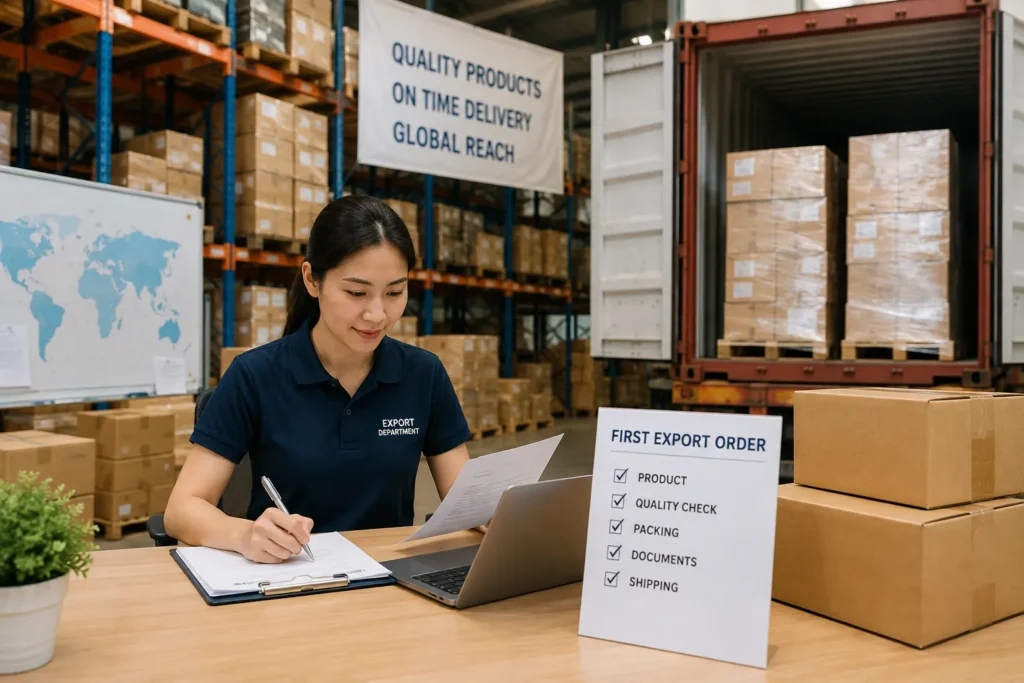
7 Key Steps in the Export Process for First-Time Exporters
The first export order is exciting.
A new overseas customer has agreed to buy. The product is ready, the price has been discussed, and both sides want to move forward.
Then the practical questions begin.
Who arranges the freight? Which documents are required? Does the product need any special export procedures? When should customs clearance begin? And when does the exporter actually get paid?
For a first-time exporter, these questions can make a seemingly simple sale feel much more complicated.
The good news is that the export process becomes much easier to understand when it is viewed as one connected journey—from confirming the order to getting the goods ready for international shipment.
Step 1: Check the Product Before Confirming the Export Order
Imagine a Vietnamese business receives its first serious inquiry from an overseas buyer.
The buyer wants the product, the quantity looks attractive, and the exporter is eager to send a quotation.
But before agreeing to the order, one question needs to come first:
Can this product actually be exported under the proposed conditions?
Different products may involve different requirements depending on the commodity and destination market.
Food, agricultural products, chemicals, machinery, wood products and other regulated goods may require additional attention to product policies, certificates, testing, permits or destination-country requirements.
💡 The export process should therefore begin with the product—not with booking the shipment.
The exporter should understand what is being sold, its specifications, likely HS classification and whether any product-specific requirements need to be addressed.
This early review can prevent much larger problems after the buyer has already placed the order.
Step 2: Make the Commercial Agreement Clear
The product can be exported. The buyer wants to proceed.
Now the commercial conversation becomes more serious.
The exporter and buyer need to agree not only on the unit price but also on what that price actually includes.
Suppose the buyer asks for:
USD 20,000 – CIF Los Angeles.
That means something very different from:
USD 20,000 – FOB Ho Chi Minh City.
Incoterms change responsibilities
The agreed Incoterm affects who handles different parts of transportation, costs and risk.
Payment terms also matter.
Will the buyer pay by T/T? Is there a deposit? Is the balance paid before shipment or against documents? Is an L/C involved?
At this stage, the commercial agreement should clearly establish key points such as product, quantity, price, Incoterm, payment terms, packing requirements and expected shipment timing.
📋 A misunderstanding at this stage can follow the shipment all the way to destination.
Step 3: Prepare the Goods and Export Documents
The order is confirmed.
Production begins.
While the factory focuses on making the goods, another process starts in parallel: preparing the documentation.
This is where first-time exporters often discover that the physical product and the document set must tell the same commercial story.
The product description, quantity, weight, value, packages and parties shown across the documents should be consistent.
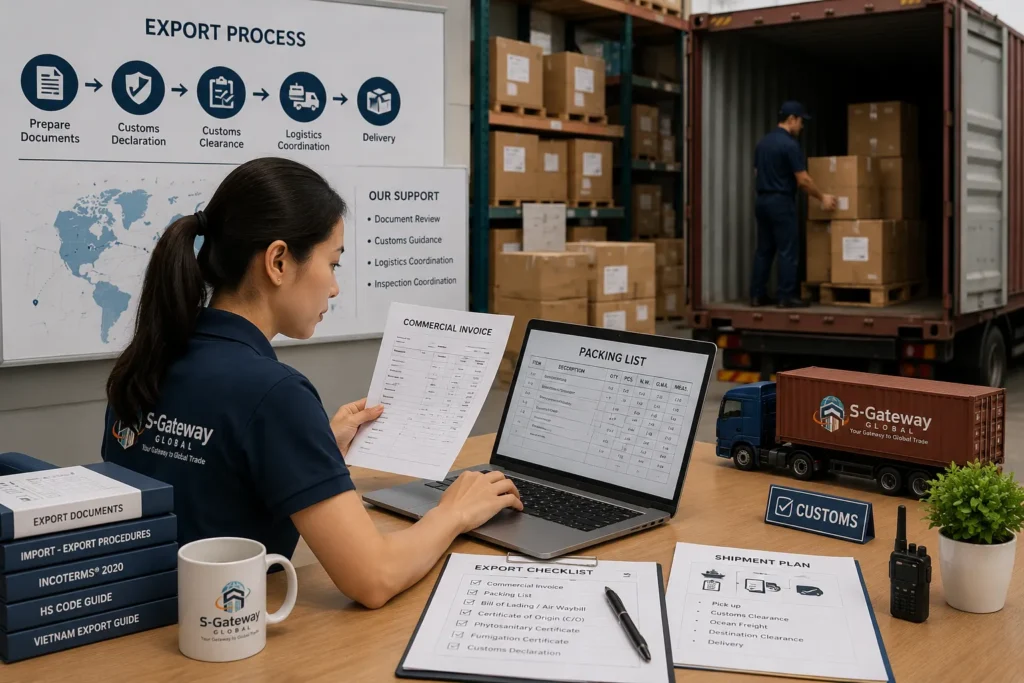
Depending on the shipment, the document set may include a commercial invoice, packing list, sales contract and other product- or market-specific documents.
Additional documents may also be required depending on the transaction—for example, a Certificate of Origin, phytosanitary certificate, health certificate, fumigation certificate or other relevant documents.
The exact requirements depend on the product, destination and commercial arrangement.
For exporters that need support reviewing this stage, S-Gateway Global’s Import & Export Support focuses on practical coordination around shipment procedures and documentation.
Step 4: Plan the Shipment Before the Cargo Is Ready
Production is almost complete.
The exporter now needs to connect the factory schedule with the international transport schedule.
This is where logistics planning becomes important.
For ocean freight, the exporter may need to work backward from the vessel schedule: booking, container availability, cargo cut-off, customs clearance and terminal requirements all need to fit together.
For air freight, the timeline is different, but coordination is still necessary.
🚢 A shipment should not be planned only after the goods are completely finished.
Waiting too long can mean missing the intended vessel or flight, paying additional storage costs or delaying delivery to the customer.
Step 5: Complete Export Customs Clearance
The goods are ready and the shipment has been planned.
Now the cargo must move through the export customs process.
The customs declaration needs to reflect the actual transaction and supporting documents.
Depending on the shipment, relevant information can include the exporter and consignee, product description, HS code, quantity, customs value, origin and other declaration details.
🔎 Accuracy matters because inconsistencies between the customs declaration and commercial documents can create delays or require clarification.
Some shipments may proceed relatively straightforwardly, while others can require document review, physical inspection or additional handling depending on the customs process and product involved.
This is why customs preparation should be connected to the documentation work that started earlier—not treated as a completely separate task at the last minute.
Step 6: Load the Goods and Finalize the Shipping Documents
Customs clearance progresses and the cargo is ready to move.
For a sea shipment, the container may be loaded at the factory or cargo may be delivered according to the agreed logistics arrangement.
Once the carrier receives the cargo, another important document enters the story: the Bill of Lading.
For air freight, the corresponding transport document is generally the Air Waybill.
The exporter should carefully review shipping details before final documents are issued.
Names, addresses, cargo descriptions, package quantities and other shipping information should align with the commercial transaction.
A small documentation error may become much harder to correct after the vessel has departed.
For projects requiring coordination between cargo readiness, transport and shipment documentation, buyers and sellers can also review our Logistics Coordination support.
Step 7: Complete the Document and Payment Cycle
The vessel departs.
For a first-time exporter, this can feel like the finish line.
But commercially, the transaction may not be finished yet.
The exporter may still need to provide documents to the buyer, bank or other parties depending on the agreed payment method.
If payment is made by T/T, the remaining balance may be linked to a particular shipment milestone.
If the transaction uses an L/C or documentary collection, document accuracy becomes even more important because the banking process has its own requirements.
Meanwhile, the importer needs the appropriate documents to continue the import process at destination.
The exporter’s responsibility therefore does not simply disappear when the container leaves Vietnam.
The final stage is about completing the agreed document flow, payment requirements and shipment handover correctly.
From the First Purchase Order to an Export Shipment
A few weeks earlier, the company had only an overseas inquiry.
Now the situation looks completely different.
The product requirements have been checked.
Commercial terms have been agreed.
The goods have been produced and packed.
Export documents have been prepared.
Customs procedures have been handled.
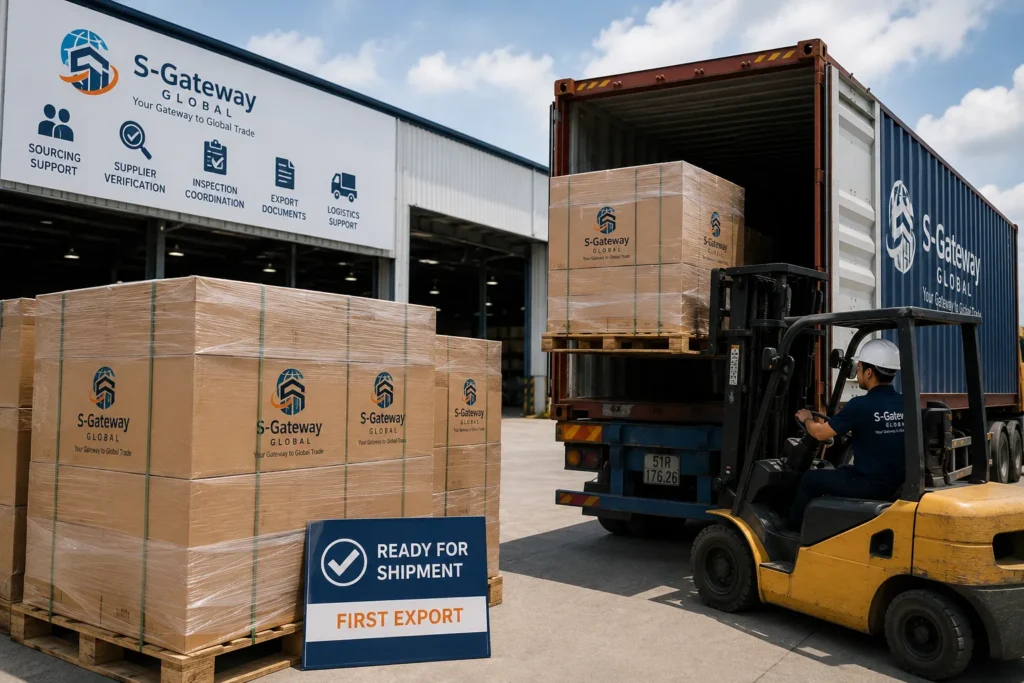
And the shipment is ready to move—or already moving—toward the overseas customer.
The first export shipment often teaches a business something important:
Exporting is not one customs declaration or one logistics booking.
It is a chain of connected decisions.
A mistake in the product requirement can affect documentation.
A mistake in the Incoterm can affect logistics costs.
A documentation error can affect customs clearance.
A shipping-document discrepancy can affect payment or destination clearance.
✅ When these steps are considered together from the beginning, the export process becomes much more manageable.
A Successful Export Starts Before the Goods Leave the Factory
For first-time exporters, the objective should not simply be to get the first shipment out of the country.
The objective is to build a process that can be repeated.
That means understanding the product requirements, agreeing clear commercial terms, preparing consistent documents, planning logistics early and coordinating customs and shipping as one connected workflow.
Once that foundation is established, the second export shipment is usually much easier to manage than the first.
Planning Your First Export Shipment?
Have a buyer or export order but are unsure about the next steps?Share your product, destination country, shipment details and current export requirements with S-Gateway Global.We can help review the practical workflow, required documentation, customs-related steps and logistics coordination before your shipment moves forward.