

How to Find Reliable Suppliers in Vietnam: A Practical Guide
A buyer decides to source a new product from Vietnam.
The first few days look promising. A Google search produces dozens of potential suppliers. B2B platforms provide even more options. Several companies respond quickly with catalogues, factory photos and competitive quotations.
Finding suppliers seems easy.
Then the quotations arrive.
One supplier offers the lowest price but requires a much higher MOQ. Another communicates well but provides limited information about production capacity. A third claims to be a manufacturer, but it is not immediately clear where the products are actually made.
The buyer started with one simple question:
“Where can I find suppliers in Vietnam?”
Now the more important question is:
“Which supplier is actually right for my business?”
For international buyers, this is where finding reliable suppliers in Vietnam becomes more than an online search. It becomes a process of research, comparison, verification and practical decision-making.
Finding a Supplier Is Only the Beginning
Vietnam offers sourcing opportunities across agricultural products, handicrafts, furniture, processed foods and many manufactured goods.
But having many options creates another problem: buyers need a way to separate promising suppliers from companies that do not fit the project.
Imagine the buyer is looking for a manufacturer for a new product line.
Instead of immediately requesting prices from every company, the buyer first defines what the product actually needs to be.
Material. Dimensions. Grade. Quantity. Packaging. Destination market. Required certifications. Expected delivery schedule.
For agricultural products, the requirement may include moisture, processing method, grade and packing size. For furniture or handicrafts, materials, finishing, construction and dimensions may matter more.
💡 A clearer product requirement usually leads to a better supplier search.
Without this information, two suppliers may quote what appears to be the same product while actually offering different specifications.
For buyers starting without an established supplier network, our Vietnam Sourcing service supports the supplier research and shortlisting process.
From Twenty Companies to a Useful Shortlist
Suppose the initial research identifies 20 potential suppliers.
The objective should not be to collect 20 quotations.
The objective is to understand which companies deserve a closer look.
Some may specialize in the exact product required. Others may have strong production capability but an MOQ that is too high for the buyer’s first order.
A smaller manufacturer may have less international marketing but be a better fit for a developing business.
This is why the supplier search gradually changes from:
“Who sells this product?”
to questions such as:
Can they produce my specification?
Can they handle my expected quantity?
What is their normal lead time?
Do they have relevant export experience?
Can they provide the documents required for my market?
How clearly do they communicate when detailed questions are asked?
🔎 After this initial screening, a list of 20 suppliers might become five.
Five relevant suppliers are far more useful than twenty company names.
When an Attractive Quotation Is Not Enough
Now imagine that three suppliers remain after the initial discussions.
Supplier A offers the lowest price.
Supplier B is slightly more expensive but responds clearly, provides detailed specifications and has experience with international orders.
Supplier C appears to have strong production capacity, but its MOQ is twice the quantity the buyer wants for the first order.
At this stage, simply comparing unit prices does not answer the most important question.
Which supplier provides the best overall fit?
A polished website, professional catalogue and competitive quotation are useful signals, but they do not tell the whole story.
Before making a meaningful commercial commitment, the buyer may need to understand who is actually behind the quotation.
Looking beyond the sales presentation
Depending on the order and level of risk, useful checks may include the company’s legal information, business location, manufacturing capability, factory information, certifications and previous export experience.
The purpose is not to assume that every unfamiliar supplier is risky.
It is to make the level of checking appropriate to the transaction.
🛡️ A small sample order and a large first production order do not necessarily require the same level of supplier verification.
When additional checks are appropriate, our Supplier Verification service can support buyers before they make a larger commitment.
The Factory and Product Tell Another Part of the Story
Eventually, sourcing needs to move beyond emails and spreadsheets.
This is where actual products, samples, facilities and production capability become important.
Perhaps Supplier A had the best price on paper, but the sample finishing is inconsistent.
Supplier B’s quotation was slightly higher, but its sample closely matches the required specification.
Supplier C produces a good product, but the factory’s minimum production quantity still does not fit the buyer’s purchasing plan.
The comparison now looks very different from the original quotation sheet.
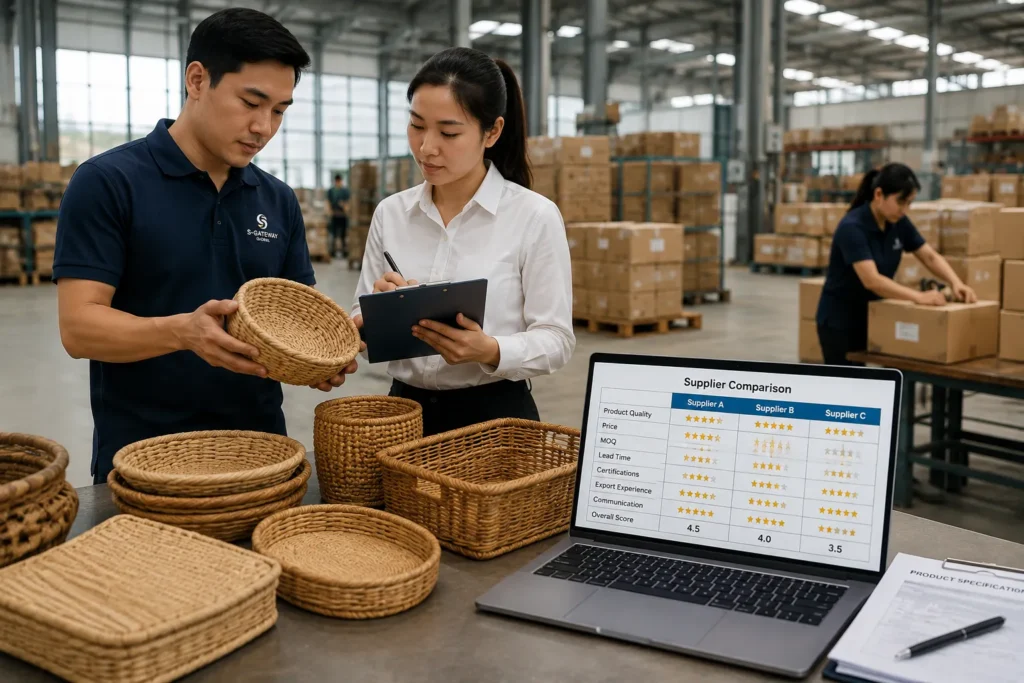
Comparing Suppliers Beyond the Lowest Price
This is the point where structured supplier comparison becomes valuable.
Price remains important, but it is considered alongside product fit, MOQ, lead time, capacity, quality, export experience and communication.
A simplified comparison might look like this:
| Factor | Supplier A | Supplier B | Supplier C |
|---|---|---|---|
| Product Fit | Good | Very Good | Good |
| Price | Lowest | Competitive | Competitive |
| MOQ | Good | Good | High |
| Lead Time | Average | Good | Good |
| Communication | Average | Strong | Good |
| Export Experience | Limited | Relevant | Strong |
| Main Concern | Quality consistency | Higher price | High MOQ |
📊 Suddenly, the lowest quotation no longer automatically looks like the best choice.
Supplier B may cost slightly more, but if the product matches the specification, communication is clearer and the MOQ fits the project, that difference may be commercially reasonable.
Another project could produce a completely different conclusion.
The purpose of supplier comparison is not to create a universal ranking.
It is to identify which supplier best fits this buyer, this product and this order.
Then the Samples Arrive
Samples often change the conversation again.
Specifications that looked similar on a spreadsheet can become noticeably different when the physical products are placed side by side.
The buyer can review material, dimensions, appearance, workmanship, packaging and other product-specific requirements.
For certain products, laboratory or technical testing may also be appropriate.
But there is an important distinction:
A good sample is evidence of capability. It is not automatically a guarantee of mass-production consistency.
If the project progresses into a larger production order, another level of quality control may therefore be considered.
Our Product Inspection Coordination service is relevant when buyers need additional coordination around product checks before shipment.
The Supplier Is Selected
After the research, conversations, verification, comparison and samples, the buyer finally makes a decision.
The supplier is selected.
Now the project begins to feel very different from that first online search.
Instead of 20 supplier names and a folder full of unrelated quotations, there is one commercial direction.
The product specification is confirmed.
MOQ and pricing are agreed.
Packaging requirements are finalized.
Payment terms and Incoterms are documented.
Production timing is established.
📋 At this stage, the buyer has moved from supplier discovery into an actual purchasing relationship.
But selecting the supplier is still not quite the end of the story.
From Approved Sample to Finished Goods
Production begins.
For a repeat order with an established supplier, the process may be straightforward.
For a larger first order, the buyer may want additional visibility before the goods leave the factory.
Do the finished products remain consistent with the approved sample?
Is the quantity correct?
Is the packaging suitable for the agreed shipment?
Are labels and markings correct?
Are there visible workmanship issues?
These questions are much easier to address before shipment than after the goods have travelled thousands of kilometres.
Where appropriate, inspection or another agreed quality-control step can provide a practical checkpoint before the goods move into the export stage.
When the Search Finally Produces a Result
Eventually, the production is completed.
The finished goods are packed.
Cartons are labelled.
Pallets are prepared.
The supplier confirms that the order is ready for the next stage.
This is the moment when the original sourcing project finally produces a tangible result.
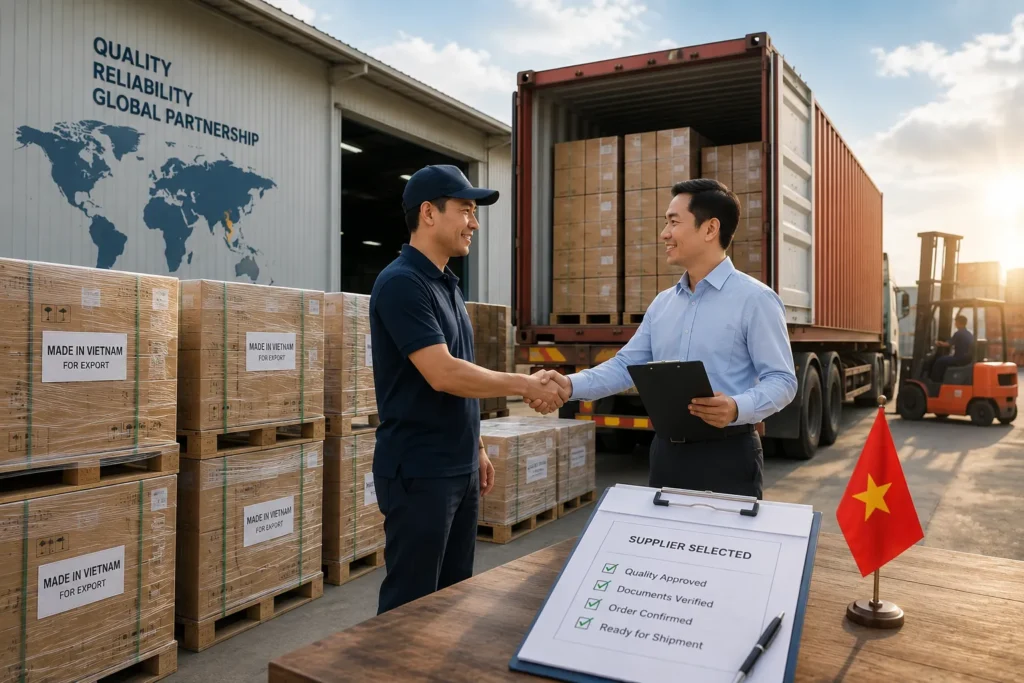
The buyer is no longer searching through supplier directories.
There is now a selected supplier, an agreed product, finished goods and a commercial relationship that has been tested through a real order.
If that first order performs well, the next conversation changes again.
Instead of asking:
“Can I trust this supplier?”
the buyer can begin asking:
“Can this supplier support larger volumes, repeat orders or a longer-term purchasing plan?”
✅ That transition—from finding a company to developing a dependable supply relationship—is where sourcing begins to create long-term value.
A Reliable Supplier Is More Than the Lowest Price
There are many ways to find suppliers in Vietnam.
The difficult part is not obtaining supplier names. It is identifying which supplier fits the buyer’s product, quantity, quality expectations, timeline and commercial requirements.
That decision rarely comes from one quotation.
It develops through clear requirements, supplier research, communication, verification, product evaluation and practical comparison.
A successful sourcing project should therefore produce more than a supplier contact.
It should create the foundation for a supply relationship that can be evaluated, managed and developed over time.
When the selected supplier is ready to move from production into shipment, buyers may also need support with export documentation, customs-related coordination and logistics. Learn more about our Import & Export Support service.
Looking for a Reliable Supplier in Vietnam?
Already have a product you want to source?Share your product details, specifications, expected quantity and destination market with S-Gateway Global.We can help research potential suppliers in Vietnam, build a practical shortlist, compare key sourcing factors and identify the next steps for your project.