

Vietnam Cashew Market Update 2026: Production, Prices, Quality & Sourcing Opportunities
A buyer looking for cashews in 2026 may begin with a simple question:
“What is the current price of W320 from Vietnam?”
But price alone does not explain the Vietnam cashew market.
Behind a quotation is a much larger supply chain involving raw cashew sourcing, processing factories, kernel grades, quality specifications, packaging, export markets and changing raw-material costs.
Vietnam entered 2026 from a strong position. In 2025, the country exported approximately 766,585 tonnes of cashews worth US$5.22 billion, setting a new record in export value. China became the largest market by value, followed by the United States and the Netherlands.
For international buyers, this combination of processing scale, established export capability and a wide range of commercial grades continues to make Vietnam an important sourcing market.
But 2026 also brings a more complicated question:
Is Vietnam still competitive on price while maintaining the quality buyers expect?
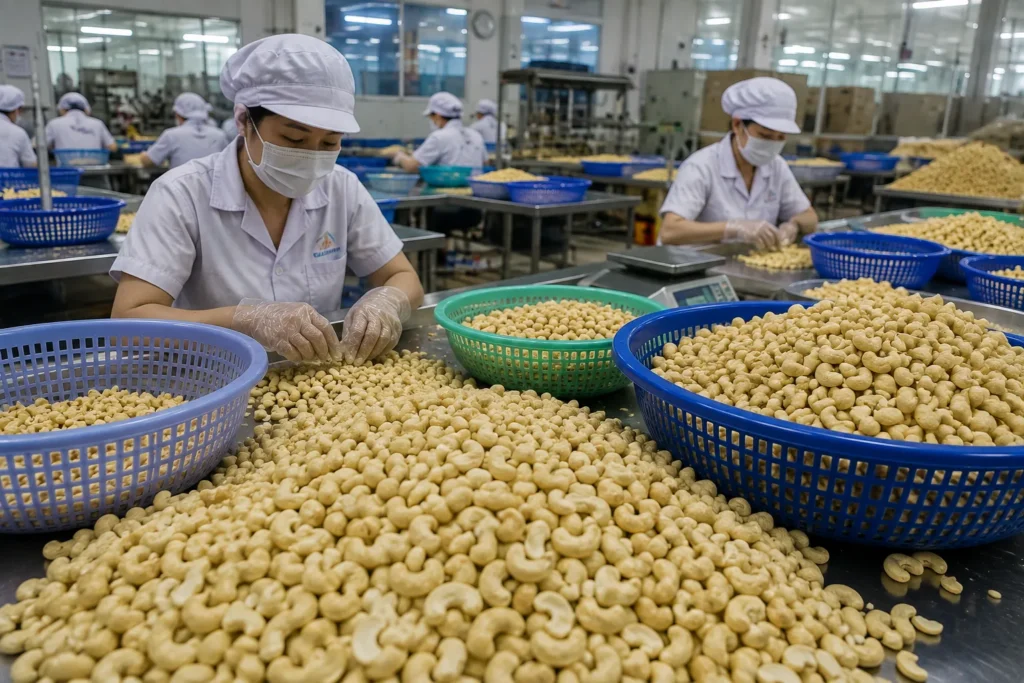
Vietnam Remains a Major Cashew Processing and Export Hub
Vietnam’s advantage in cashews is not simply the amount of cashew trees grown domestically.
Its bigger strength is the processing ecosystem that has developed around the industry.
Factories process raw cashew nuts into standardized kernel grades for international markets, including familiar commercial products such as:
- WW180 / W180
- WW240 / W240
- WW320 / W320
- W450
- WS
- LP and SP
Among these, W320/WW320 remains one of the most important commercial grades, offering buyers a practical balance between kernel size, appearance and cost.
Vietnam’s 2026 export activity has remained substantial. Customs-based reporting shows exports of about 268,408 tonnes worth US$1.87 billion during the first five months of 2026. China and the United States remained the two largest markets, while European markets including the Netherlands and Germany also continued purchasing significant volumes.
This matters for a buyer because a mature export industry usually means more than production capacity.
It also means access to suppliers familiar with international specifications, commercial packaging, documentation and overseas shipment requirements.
🌍 Vietnam’s competitive position therefore comes from processing capability and export infrastructure as much as from domestic cultivation.
The Important Detail: Vietnam Processes More Cashews Than It Grows
This is one of the most important things an international buyer should understand about the Vietnamese cashew industry.
A product processed in Vietnam does not necessarily mean that the raw cashew nut was grown in Vietnam.
Vietnam’s processing capacity is much larger than its domestic raw-material supply.
In 2025, Vietnamese businesses reportedly imported around 3 million tonnes of raw cashew nuts, worth nearly US$4.5 billion. Cambodia was the largest source by value, followed by Côte d’Ivoire, Nigeria and Ghana.
More than half of imported raw cashews also come from Africa, according to industry reporting.
That creates both an advantage and a risk.
The advantage
Vietnamese processors can work with a broad international raw-material supply base rather than depending entirely on one domestic crop.
This supports large processing volumes.
The risk
Changes in raw cashew prices, crop conditions, African export policies, transportation costs and competition from processing countries can influence Vietnamese kernel prices.
💡 For buyers, “processed in Vietnam” and “Vietnam-grown origin” should therefore not automatically be treated as the same specification.
If origin is commercially important, it should be clarified with the supplier before ordering.
What Is Happening to Vietnam Cashew Prices in 2026?
This is where the market becomes particularly interesting.
Price movement has not been identical across all grades.
Published FOB Ho Chi Minh indications from one Vietnamese exporter showed approximately:
| Grade | March 2026 | Mid-July 2026 |
|---|---|---|
| WW180 | $8.90/kg | $9.60/kg |
| WW240 | $7.50/kg | $7.90/kg |
| WW320 | $6.85/kg | $7.00/kg |
These are market indications from an individual exporter rather than an official national price list, so they should be used as reference points rather than universal quotations.
The pattern is nevertheless useful.
WW320 remained comparatively stable through much of the first half of 2026, while larger premium grades such as WW240 strengthened.
One market series tracked WW320 around US$7.00–7.20/kg FOB Ho Chi Minh during the first half of the year, while WW240 moved from approximately US$7.40 to US$7.90/kg.
📊 This widening difference matters because buyers should not talk about “the cashew price” as though every grade moves together.
Why W320 Remains Important for International Buyers
Imagine two buyers contacting the same Vietnamese supplier.
The first is developing a premium retail product where large, visually attractive whole kernels are important.
The second needs cashews for mainstream snack packs sold through supermarkets.
They should not necessarily buy the same grade.
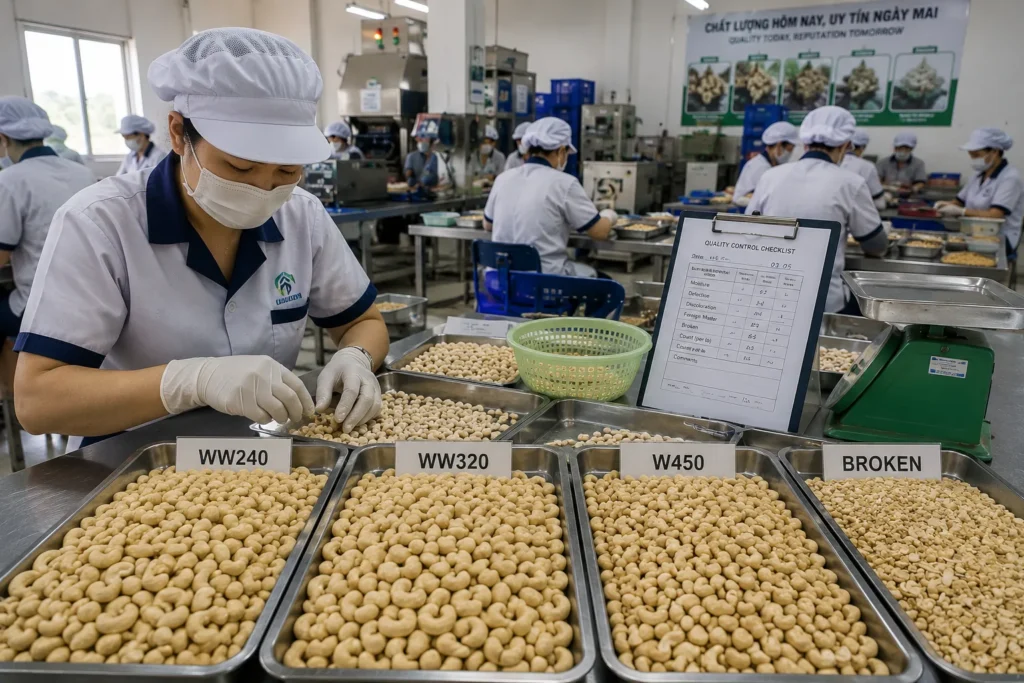
WW240 offers larger kernels and can be more attractive for premium presentation.
WW320 is generally more economical while still providing the whole-kernel appearance required by many retail and foodservice applications.
Broken grades such as LP and SP may make more commercial sense for products where appearance is less important—for example, ingredients, bakery applications, confectionery or further processing.
May 2026 shipment data illustrates the importance of WW320: reported exports of that declared grade reached more than 21,500 tonnes during the month, with an average reported price around US$7.05/kg.
The sourcing question therefore should not simply be:
“What is your cheapest cashew?”
A better question is:
“Which grade gives me the right balance of appearance, specification and cost for my market?”
Vietnam’s Quality Advantage Is Really a Processing Advantage
Vietnamese cashews have a strong reputation internationally, but buyers should understand what creates that reputation.
The country’s advantage is closely connected with decades of commercial processing experience.
Modern cashew processing involves several stages before kernels are ready for export:
Raw cashew → steaming/conditioning → shelling → drying → peeling → grading → quality control → packing
The result can then be separated into different whole, scorched and broken grades according to commercial requirements.
For buyers, however, a grade name alone is not enough.
Two suppliers offering “WW320” may still differ in areas such as:
- moisture
- defect tolerance
- colour
- broken percentage
- foreign matter
- microbiological requirements
- packaging
- consistency between lots
🔎 The specification behind the grade is therefore as important as the grade itself.
For a serious commercial order, buyers should request the relevant product specification and clarify the applicable quality standard rather than purchasing only from photographs and a grade name.
For buyers who have already identified potential factories, S-Gateway Global’s Supplier Verification support can help with preliminary supplier checks before moving to a larger commercial commitment.
Is Vietnam Still Competitive on Cost?
Yes—but “competitive” should not automatically mean “the lowest possible quotation.”
Vietnam’s scale creates several commercial advantages.
There is a large network of processors and exporters. Buyers can source multiple grades. Suppliers may offer bulk export packing, retail products, roasted cashews or private-label options depending on capability.
And because the industry already exports to large markets, many established processors are familiar with international trading and shipping requirements.
At the same time, raw-material costs remain a major variable.
Vietnam’s dependence on imported raw cashew nuts means changes in African and Cambodian supply can flow through to processing costs.
The result is that buyers should compare total commercial value, not just the first FOB quotation.
A supplier that is slightly cheaper but cannot consistently meet the required specification may ultimately be more expensive once claims, rejected goods or supply disruptions are considered.
What Buyers Should Compare Before Selecting a Cashew Supplier
Suppose a buyer receives three offers:
Supplier A: WW320 at the lowest price.
Supplier B: slightly higher price, clear specification, relevant certificates and good communication.
Supplier C: competitive pricing and attractive packaging, but limited information about production capacity.
At first glance, Supplier A wins.
After comparison, the answer may change.
⚖️ Useful factors include product grade and specification, raw-material origin when relevant, factory capability, certifications, sample quality, MOQ, packing format, lead time, payment terms and export experience.
The supplier also needs to fit the buyer’s destination market.
Requirements for a bulk ingredient importer can differ significantly from those of a supermarket private-label program.
For buyers who do not yet have a supplier shortlist, our Vietnam Sourcing service focuses on researching suppliers and comparing practical sourcing factors rather than simply collecting company names.
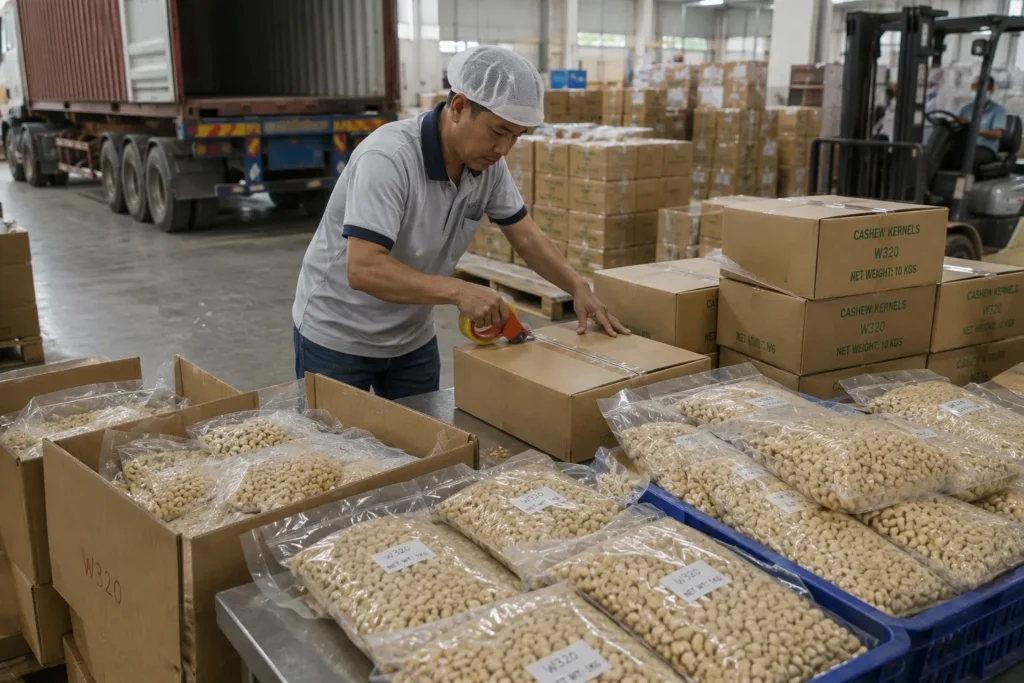
From Cashew Factory to Export-Ready Product
Once a supplier has been shortlisted, the sourcing process becomes more tangible.
Samples can be reviewed.
Specifications can be compared.
Packaging can be confirmed.
Commercial terms can be negotiated.
For larger orders, buyers may also consider appropriate product checks before shipment.
The goal is not to find a theoretically “perfect” supplier.
It is to identify a supplier whose product, quality system, capacity, pricing and communication are appropriate for the intended business.
What the 2026 Market Means for Buyers
Vietnam entered 2026 with significant momentum after its record export performance in 2025.
Demand remains geographically diversified across China, the United States, Europe and other markets. At the same time, the industry faces pressure from raw-material costs, imported supply dependence and increasing competition from producing countries that want to process more cashews domestically.
For buyers, that creates an interesting sourcing environment.
Vietnam still provides access to a large processing ecosystem and a broad range of commercially established cashew grades.
But purchasing decisions should increasingly be based on grade + specification + supplier capability + origin requirements + current price, rather than price alone.
✅ The cheapest W320 quotation is not necessarily the best sourcing decision.
The better objective is to find the specification and supplier combination that fits the buyer’s market.
Vietnam Cashew Sourcing in 2026: Scale Still Matters, but Selection Matters More
Vietnam’s cashew advantage has evolved.
It is no longer simply a story about growing cashew nuts.
It is a story about processing scale, international raw-material sourcing, grading capability, export experience and established global demand.
For international buyers, this creates real sourcing opportunities across whole kernels, premium grades, broken grades and processed products.
But the market also rewards careful purchasing.
Understanding exactly what is being quoted—and comparing suppliers on more than price—is increasingly important in 2026.
Looking for Cashew Suppliers in Vietnam?
If you are sourcing W240, W320, W450, SP, LP or other cashew products from Vietnam, send us your target grade, specification, quantity, packaging requirement and destination market.S-Gateway Global can support supplier research, preliminary comparison, supplier verification and practical export/logistics coordination depending on your project requirements. This matches the brand’s practical, non-overpromising sourcing and trade positioning.