

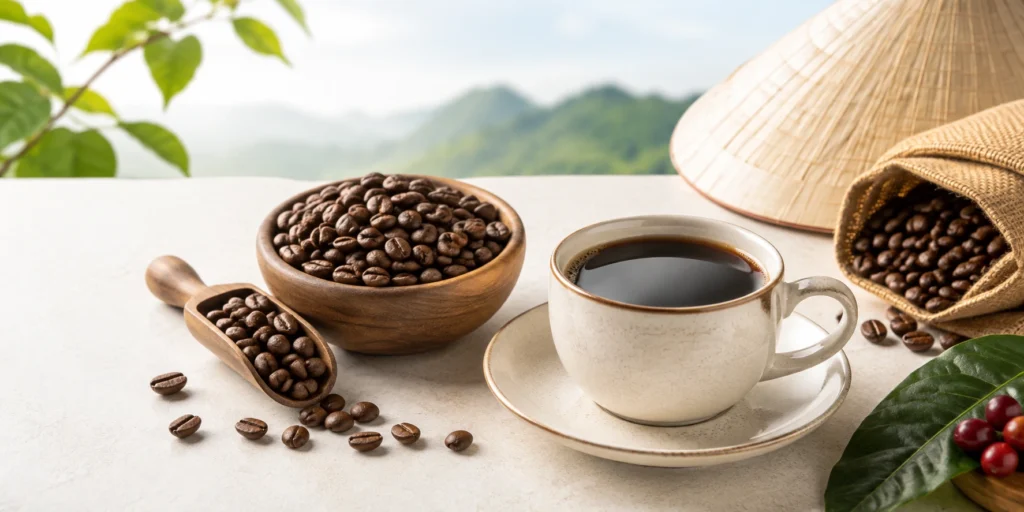
Vietnam is one of the world’s most important coffee-producing and exporting countries. Known especially for Robusta coffee, Vietnam has built a strong position in the global coffee supply chain and continues to attract international buyers looking for reliable sourcing options.
For importers, distributors, coffee brands, roasters, and private-label buyers, Vietnam offers several opportunities across green coffee beans, roasted coffee, ground coffee, instant coffee, and customized packaging.
However, successful coffee sourcing is not only about finding a supplier. Buyers also need to understand product types, quality specifications, certifications, supplier capability, export documents, and shipment coordination before moving forward.
1. Market Overview
Vietnam is widely known as a major Robusta coffee origin. Vietnamese Robusta is commonly used in instant coffee, commercial blends, espresso blends, and food service supply.
In recent years, Vietnam’s coffee industry has also seen growing interest in Arabica, specialty coffee, roasted coffee, ground coffee, and soluble coffee products. This creates more options for buyers who are not only looking for raw green beans but also value-added coffee products.
Vietnam’s coffee export value has increased strongly in recent years. Higher global coffee prices, strong demand, and improved processing capacity have supported the industry’s export performance.
For international buyers, this means Vietnam is not only a low-cost sourcing destination. It is also becoming a more competitive origin for processed coffee and branded coffee products.
2. Coffee Products Buyers Can Source from Vietnam
Buyers can source different coffee products from Vietnam depending on their target market, price segment, and business model.
Common coffee product options include:
Robusta green coffee beans
Arabica green coffee beans
Roasted coffee beans
Ground coffee
Instant coffee
Freeze-dried coffee
3-in-1 coffee mix
Private-label coffee products
Retail coffee packaging
Bulk coffee for repacking or roasting
Each product type requires a different sourcing approach.
For example, a buyer sourcing green Robusta beans should focus on screen size, moisture, defects, origin, grade, and packing. A buyer sourcing roasted coffee should check roast profile, flavor, shelf life, packaging material, and labeling requirements. A buyer sourcing private-label coffee should also review design, MOQ, printing options, and production lead time.
3. Why International Buyers Consider Vietnam Coffee
Vietnam has several advantages as a coffee sourcing destination.
First, Vietnam has strong production capacity. This allows buyers to source at different volume levels, from sample orders and trial shipments to larger commercial orders.
Second, Vietnam has experience in coffee export. Many suppliers are familiar with export documentation, container loading, international payment terms, and overseas buyer requirements.
Third, Vietnam offers a wide product range. Buyers can source raw coffee beans, processed coffee, retail packs, private-label products, and instant coffee from different supplier groups.
Fourth, Vietnam can support competitive pricing in many coffee segments. However, buyers should remember that the lowest price is not always the best option. Coffee quality, supplier reliability, documentation, and consistency are equally important.
4. What Buyers Should Check Before Choosing a Coffee Supplier
Before confirming a supplier, buyers should review several important points.
Product specifications should be clear from the beginning. For green coffee beans, buyers should check moisture, defects, screen size, grade, origin, crop year, and packing. For roasted or ground coffee, buyers should review roast level, flavor profile, grind size, shelf life, and packaging.
Certifications may be required depending on the target market. Common documents may include ISO, HACCP, Organic, Rainforest Alliance, 4C, or other food safety and sustainability-related certificates. The required certificate depends on the buyer’s market and customer requirements.
Supplier capability should also be reviewed. Buyers should check whether the supplier is a trader, processor, factory, or exporter. This affects pricing, communication, product control, and production capacity.
Export experience is important. A supplier with export experience is more likely to understand packing, shipping marks, documents, lead time, and shipment coordination.
Samples should be reviewed before bulk orders. For coffee, sample testing is important because visual appearance alone does not show full product quality.
5. Common Documents for Coffee Export from Vietnam
The required documents may vary depending on the destination country, buyer requirements, and product type. However, common export documents may include:
Commercial Invoice
Packing List
Bill of Lading
Certificate of Origin
Phytosanitary Certificate, if required
Fumigation Certificate, if required
Health Certificate or food safety documents, if required
Certificate of Analysis, if requested
Quality or weight certificate, if applicable
Buyers should confirm document requirements before shipment. Missing or incorrect documents may cause customs delays, extra costs, or difficulties at destination.
For agricultural products such as coffee, documentation should be checked carefully before loading. This is especially important when buyers need origin documents, food safety documents, or certificates for customs clearance in their country.
6. Private Label and Packaging Opportunities
Vietnam can also support buyers who want private-label coffee products.
Private-label options may include retail coffee bags, printed packaging, branded coffee boxes, coffee drip bags, instant coffee packs, and customized blends.
Before starting a private-label project, buyers should prepare clear information:
Target product type
Brand positioning
Packaging size
Packaging material
Design file
Expected quantity
Target market
Required certificates
Shelf life requirement
Labeling language
Barcode or retail requirements
Private-label projects often require more communication than bulk green coffee sourcing. Buyers should confirm MOQ, packaging cost, design approval, sample production, lead time, and final packing details before placing an order.
7. Practical Sourcing Notes
When sourcing coffee from Vietnam, buyers should avoid making decisions based only on price. Coffee products may look similar in a quotation, but differences in grade, moisture, defects, packaging, certificates, and supplier reliability can affect the final result.
A practical sourcing process should include:
Clear product requirement
Supplier search
Supplier shortlisting
Quotation comparison
Sample request
Specification review
Document check
Payment and shipment discussion
Final supplier selection
It is also useful to compare at least two or three suppliers before confirming an order. A supplier comparison helps buyers understand market price, MOQ, lead time, quality level, communication, and export readiness.
8. Conclusion
Vietnam coffee export offers strong opportunities for international buyers. From Robusta and Arabica beans to roasted coffee, ground coffee, instant coffee, and private-label products, Vietnam has a wide range of coffee sourcing options.
However, successful sourcing requires a clear process. Buyers should define product specifications, check supplier capability, review samples, confirm documents, and compare suppliers carefully.
With the right sourcing approach, Vietnam can be a valuable coffee supply market for importers, distributors, roasters, coffee brands, and global buyers looking for reliable long-term partnerships.
Looking for reliable coffee suppliers in Vietnam?
Share your coffee sourcing requirement with S-Gateway Global. We can help review product specifications, supplier options, export documents, and practical next steps before you move forward.